What does the US climate bill mean for construction there?

Two US green building websites - Green Building Law and Green Building Law Update - have trudged through the climate bill that's moving through the US congress to tease out what it means for construction standards in the US. Treehugger synopsises their points here. In essence, the bill:

Establishes a national energy efficiency code for both residental and commerical buildings. 

Mandates an immediate 30 per cent reduction in building energy demand for new build, and a 50 per cent reduction in five years. From reading Treehugger's report, it's not clear if this refers to heating energy demand or overall demand.

Increases funding for national Retrofit for Energy and Environmental Performance (REEP) programs, which assist building retrofits designed to improve energy and water efficiency.

TreeHugger believes some of the measures will face considerable opposition: 

There is a reason that building and planning codes are local: the real estate industry is the biggest financial contributor to the election campaigns of local politicians, and the builders get what they want in the regulations. Federalizing the code will be fought tooth and nail by local and state politicians who will see it as a direct attack on their biggest source of income. At the local and state level they are concerned about Bob the Builder making houses and keeping Larry the Lumber Guy selling 2x4s, not about global climate change. But climate change is a global and national issue, and has to be dealt with at that level.



US climate change bill: thumbs up or down?

Democrats in the US Congress are expected to pass Barack Obama's climate change bill tomorrow. The bill aims to cut US emissions to 17 per cent below their 2005 level by 2020, with an 80 per cent reduction targeted for 2050. 

Writing in the Guardian, George Monbiot pointed out some serious flaws in the bill: 

The cut proposed by 2020 is just 17%, which means that most of the reduction will take place towards the end of the period. What this means is much greater cumulative emissions, which is the only measure that counts. Worse still, it is riddled with so many loopholes and concessions that the bill's measures might not offset the emissions from the paper it's printed on...

There are mind-boggling concessions to the biofuels industry, including a promise not to investigate its wider environmental impacts. There's a provision to allow industry to use 2bn tonnes of carbon offsets a year, which include highly unstable carbon sinks like crop residues left in the soil (another concession won by the powerful farm lobby). These offsets are so generous that if all of them are used, US industry will have to make no carbon cuts at all until 2026.

While environmentalists acknowledge the flaws in the bill, many say that it must be passed to provide a stepping stone for stricter cuts in future. Mobiot seems to agree: 

Even so, I would like to see the bill passed, as it at least provides a framework for future improvements. But why do we expect so little from the US? Why do we treat the world's most powerful and innovative nation as if it were a failed state, rejoicing at even the faintest suggestion of common sense?


David MacKay's one per cent rule

David MacKay - author of the influential book Sustainable Energy: Without Hot Air - proposes a smart idea in the Guardian today: that a gadget should only really be discussed if it can lead to energy savings of 1 per cent or greater.

MacKay suggests this in discussing 'kinetic energy plates' in a supermarket car park, designed to capture energy as cars pass over them. MacKay writes: 

Let's guess that the kinetic road plates extract one fifth of the kinetic energy of the arriving car. For a car weighing one tonne travelling at 20mph when it hits the road plates, the extracted energy comes to 0.002 kilowatt-hours (kWh). Now, the energy used by the car, assuming it is driven three miles to and three miles from the supermarket with a fuel efficiency of 33 miles per gallon, is about 8 kWh. The savings from parking at the green car park thus amount to one four-thousandth of the energy used by the trip to the supermarket.

That's much less than 1%. So this "green energy system" is just eco-bling, creating a delusion of happy progress while distracting people from serious change.


'Free energy' firm fails to convince scientists

Writing in the Irish Times today, science editor Dick Ahlstrom says:

 A much-trumpeted plan for limitless supplies of free energy has been dashed by the revelation that something cannot be produced from nothing.

An Irish company had promised it could deliver non-polluting, virtually cost-free power but an international jury said yesterday it did not work.

However the verdict has not deterred the company, Steorn Ltd, from continuing to develop a magnetism-based technology it calls “Orbo”. “It is a disappointment, but we had seen this coming for quite a while,” chief executive Seán McCarthy said yesterday.

Steorn took out an ad in the Economist a few years back looking to recruit an international team of scientists to review their device. But the panel has now announced that it is to disband, stating on its website

“The unanimous verdict of the jury is that Steorn’s attempts to demonstrate the claim have not shown the production of energy,” it stated. “The jury is therefore ceasing work.”

Steorn, which employs 22 people, remains undeterred - the company is inviting 300 engineering companies to sign a developer licence agreement giving them access to the technology. 


Could immersion tanks be used to balance wind and solar energy supply?

The humble electric immersion could play a key role in fighting climate change, according to Dr Mark Barrett, a rearcher at the Energy Institute at University College London.

According to the Guardian

Dr Barrett says the heaters could be switched on and off rapidly to compensate for the erratic output of wind turbines and solar panels, each heater controlled by a gadget that responds to signals sent through the electricity grid – a system used since the second world war. "Everybody is always looking for a shiny new silver-bullet solution" says Dr Barrett, "but this idea is cheap, safe, and based on technology that's been around for decades"....

...Dr Barrett explains that 19m domestic tanks, each fitted with a standard 3kW (kilowatt) immersion heater, would provide over 55GW of potentially flexible demand, which could be adjusted to suit the output of renewable generators. The immersion controller would ensure the water temperature stays above a set minimum – so the house would never be without a hot shower – but within a range of 45C-65C the grid would be in control. Along with hot-water storage in commercial buildings, this would provide balancing capacity greater than peak consumption today, and is a key feature of the computer model Dr Barrett has devised to investigate how Britain could best achieve a high proportion of renewable power.

Over 40,000 Building Energy Ratings issued in six months

ber_chart.gif
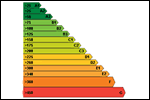
Sustainable Energy Ireland has today announced new figures for the Building Energy Rating scheme which show that over 40,000 BER certificates have been issued by SEI since 1 January  2009 when it became mandatory by law for all homes offered for sale or rent to have a BER.

Unprecedented interest in Home Energy Saving scheme

bonded_bead.jpg
Energy minister Eamon Ryan TD has announced that the recently-launched Home Energy Saving scheme has proven immensely popular among Irish homeowners.

In just four months since the scheme was officially announced, over €16 million in insulation grants is being paid to approximately 12,000 homes nationwide. Over 2,000 construction workers and tradespeople have registered to carry out the works, with a similar level of Building Energy Rating (BER) assessors involved.