

- Product News
- Posted
Straw houses could help meet housing targets and cut emissions
A new study suggests the biggest barriers to greener construction are not material scarcity but systems and policy.
Want immediate access to all back issues of Passive House Plus and exclusive extra content? Click here to subscribe for as little as €20, or click here to receive the next issue free of charge
The UK could meet its housing targets of up to 300,000 new homes each year, swapping high-carbon building materials for straw without running out of supply, according to new research.
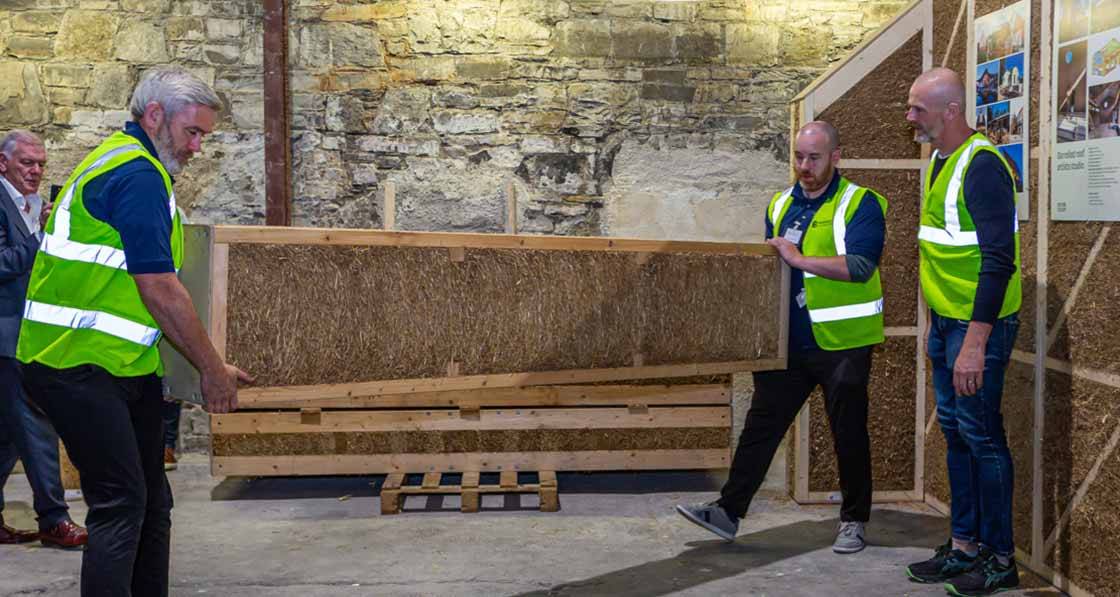
The UK produces around 9.9 million tonnes of straw every year, far more than researchers claim would be needed as a construction material to meet the government’s housebuilding targets. For context, commercially available strawbale panel systems on the UK and Ireland market from EcoCocon come at a density of 115 kg of straw per M3. At an average thickness of 400 mm, this represents a potential output of over 200 million m2 of panels – enough to build roughly a million homes per year.
Agricultural straw is a co-product of cereal farming and could replace high-emission materials such as concrete and steel, while storing biogenic carbon in buildings for the lifespan of the building. Using straw in construction could also diversify farmers’ revenue streams by turning an underutilised byproduct into a higher‑value building material.
Studies have already highlighted the promise of straw as a high-performing, low-carbon building material, with an Environmental Product Declaration (EPD) for British straw co-created by Passive House Plus contributor John Butler demonstrating exceptionally low embodied carbon for the material. Now, researchers at the University of Bath suggest the key barrier to adopting straw houses is not the availability of the raw material, but the need for stronger supply chains, clearer regulation, and greater acceptance in the construction industry.
Cutting emissions from construction
Construction currently generates around a quarter of the UK’s carbon emissions, with most of these tied up in the production of materials like steel and clinker for cement. However, straw bale houses offer a promising alternative, with the potential to build highly insulated, structural walls in low-rise buildings, delivering better moisture regulation and indoor air quality.
Charlotte Taylor, a researcher in the Department of Architecture and Civil Engineering and the study’s lead author, said: “Straw is an incredibly common resource here in the UK. It’s used as livestock bedding and feed or ploughed back into fields to improve the soil. It’s also used for energy generation, horticulture, and even mushroom cultivation.
“However, despite being a renewable, low-carbon and historically important building material, very little straw is currently used in construction. In the UK, less than 20 new homes a year are built using it as a material.” The study shows that scaling up straw construction could not only significantly cut emissions from building construction but could store between 1.8 and 3.1 million tonnes of carbon dioxide every year, locking this away for the lifespan of the buildings.
Unlocking the UK’s straw supply
Researchers analysed how straw is currently used and evaluated multiple scenarios for redirecting its supply into construction.
They found that diverting straw from other sectors, such as reallocating the supply from bioenergy or industrial uses, would provide enough material to build up to 300,000 low-rise buildings, and just 60 per cent of the straw left in fields would be needed to satisfy this demand. Growing more straw on currently unused land could supply enough material for around 163,000 homes, with diversion from other industries needed to meet housing targets.
Even accounting for fluctuations in crop yields and demand, the UK has a consistent surplus of straw relative to what would be needed for construction.
Barriers beyond supply
Despite this strong resource base, the adoption of straw as a construction material remains low. The study highlights that the barriers extend beyond the availability of the raw material and instead point to systemic obstacles in construction and agriculture.
These include the lack of established supply chains between farms and building sites, a limited pool of specialised builders familiar with straw-based construction, and slow uptake due to builders, lenders and insurers looking to minimise the risk of alternative materials.
Additional challenges are economic, as some straw construction methods are currently less efficient than conventional methods, and logistical, with straw production unevenly distributed across the UK, leading to complications in storage and transit.
The findings suggest that straw provides a clear opportunity for the UK to cut construction emissions while accelerating homebuilding significantly; however, coordinated policy support, regulation and market incentives are needed to unlock straw’s true potential.
Related items
-
 Widespread insulation failures found in EU tests
 -
 Kingspan fined €40 million by EU
 -
 Households feeling the heat of global oil conflict
 -
 New and enhanced Irish retrofit grants go live on 6 October
 -
 Campaigners tell Irish government to publish Climate Action Plan
 -
 Central Bank: Irish housing completions set to fall as housing crisis continues