
- Marketplace
- Posted
New Ejot profile cuts thermal bridging losses by 25mm insulation equivalent
A thermal bridging issue that has long plagued external wall insulation systems at building base levels could be costing homeowners the equivalent of 25 mm of insulation thickness, according to new independent testing.
This article was originally published in issue 51 of Passive House Plus magazine. Want immediate access to all back issues and exclusive extra content? Click here to subscribe for as little as €20, or click here to receive the next issue free of charge
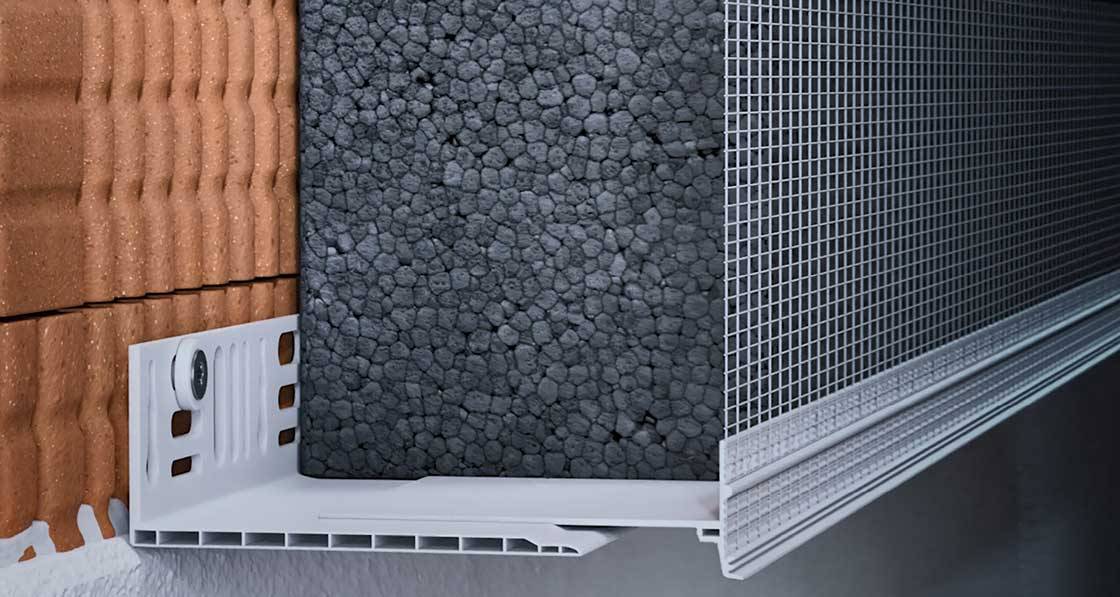
EJOT says the latest developments in its Pro-Line range of ETICS (External Thermal Insulation Composite Systems) profiles enable system designers and installers to enhance the thermal performance of external wall insulation (EWI) systems because they address a well-known thermal bridge risk. This occurs at the base of the system where the base profile and bead is positioned above the damp proof course (DPC) and the plinth insulation with the aim of preventing cold bridging. The best practice guide produced by the Insulated Render and Cladding Association (INCA) recommends that plinth insulation below the DPC has a thickness less than the main insulation above the base board to create a step and drip between the two elements. In addition, the type of insulation used for the plinth should have low moisture uptake properties, which is normally specified by system designers for each project.
The thermal bridge issue that occurs at the base of the system stems from the regular, horizontal heat flow being deflected downwards from the upper insulation board. As a result, the heat does not flow over the entire insulation thickness as it would at points higher up the wall, resulting in the potential for additional heat loss.
Base profiles or starter tracks are historically manufactured from metal, typically aluminium, primarily to offer installers a lightweight solution that is easy to work with and one that will not rust or degrade over the lifespan of the EWI system. However, given the relatively high thermal conductivity of aluminium, R&D teams at profile manufacturers seeking to address the thermal bridging effect have turned to PVC as an alternative material for base profiles, albeit with limitations on design.
Whilst PVC base profiles represent an important step forward in terms of reducing heat transfer through the profile, one viewpoint has been that they lack the rigidity offered by aluminium. Hence why systems providers and installers would default to aluminium.
This is, however, no longer a concern thanks to the R&D team at EJOT Germany. Their extensive expertise and experience puts them in the top tier of designers of components, profiles and beads for ETICS worldwide, with a wealth of materials knowledge and test data to inform and shape new product developments. The company has developed a patent-pending solution intended to address concerns about PVC’s ability to match the rigidity of aluminium with a new type of PVC base profile and base bead combination that offers the best of both worlds. It has a thermal conductivity even lower than that of standard PVC profiles and a rigidity which not only matches that of aluminium but exceeds it.
The major innovation developed by EJOT is the Pro BSOP-HL base board which has a hollow-chamber construction to add strength, unlike other PVC base profiles on the market which are solid and have a tendency to flex. Pro BSOP-HL’s structure is the key to its enhanced rigidity and reduction in thermal conductivity. The Pro BSOP-HL base profile is available in three depths and is designed to be mechanically fixed to the substrate above the plinth insulation. Once in position, it can be combined with the three depths of SOP bead profile, to cover a full range of insulation thicknesses from 60 mm up to 300 mm. In the process of developing the new base profile and bead combination, the EJOT team appointed a respected independent German testing organisation to evaluate its thermal performance versus rigid PVC and aluminium base profiles of various thicknesses of material.
The testing conducted at FIW München considered how each of these materials and designs would perform when installed as part of an EWI system on the facades of small, medium and large detached houses. The study also looked at what the impact would be with two thicknesses of plinth insulation, 50 mm and 100 mm, using industry standard calculations.
The report prepared by FIW München revealed that, whilst there was only a slight improvement in the thermal performance provided by the hollow chamber Pro BSOP-HL compared to the rigid PVC base boards, notwithstanding the structural advantages of the Pro BSOP-HL, there were significant advantages over the various thicknesses of aluminium profiles.
To highlight how much a PVC base profile could improve a house’s overall thermal performance, researchers calculated that to compensate for the use of a 2 mm thick aluminium base profile instead of the Pro BSOP-HL/Pro SOP combination, the insulation thickness of the systems’ main insulation board would need to increase by 25 mm. This was the calculation for an EWI system applied to a small, detached house where a 50 mm thick plinth insulation is used.
FIW München’s research provides reliable data to demonstrate how effectively the Pro BSOP-HL/Pro SOP combination is at reducing the thermal bridging effect at that critical point in the EWI system. Overall, that could enable major savings financially and in terms of material usage, EJOT says.
Find out more at: www.ejot.co.uk.